GATE CITY – The Scott County Board of Supervisors revisited history Wednesday regarding the Constitution’s Second Amendment and was cautioned repeatedly about speaking on matters concerning a lawsuit over out-of-state students in county schools.
In a unanimous vote, the board echoed a December 2019 resolution declaring Scott County a Second Amendment sanctuary.
Tuesday’s resolution – offered by Supervisor-at-large Stephanie Addington and seconded by District 1 Supervisor Darrel Jeter – declares that the county will “not exercise any authority granted to it by § 15.2-915(E) of the Code of Virginia to regulate or prohibit the otherwise legal purchase, possession, or transfer of firearms or ammunition.”
Section 15.20915(E) allows localities to prohibit transportation or carrying of firearms, ammunition or components in public government buildings, parks, recreational facilities or public streets and rights-of-way.
Addington’s resolution cited tourism and a ”patchwork of local ordinances" statewide as part of the reason not to enforce state law regarding localities gun ordinances.
Before the resolution, Hiltons resident and business owner Jeff Arrington asked the board to affirm what he called “our unalienable rights from our creator.”
“Although no expiration date was set on that (2019) resolution,” said Arrington, “I’m here today requesting that this board reaffirm that resolution.”
Citing what he said are a range of state gun control legislative proposals being filed for the 2026 General Assembly session under Governor-elect Abigail Spanberger’s term, Arrington said a new resolution would “serve to assert and preserve the individual right even in the face of overwhelming resistance.”
County resident Donald Purdie also asked the board to consider Arrington’s request.
School enrollment
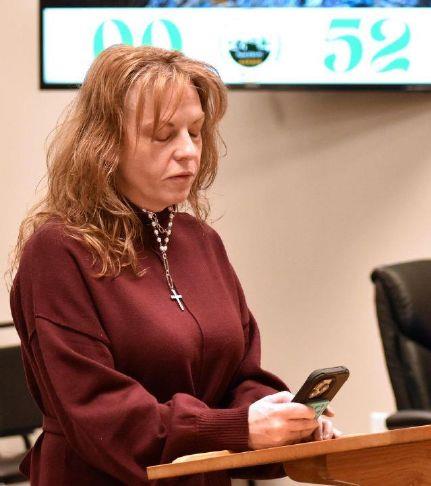
Resident Bobbie Ann Powers - who sued the Board of Supervisors, Scott County School Board and School Superintendent John Ferguson on Halloween - asked during public comment for the board to release a copy of what she claimed was a reciprocal agreement between Scott County and neighboring East Tennessee counties to allow Tennessee student enrollment.
Powers, reading from notes on her cell phone, claimed that the county was allowing a “massive financial crisis” by allowing Tennessee school students to enroll in county schools without paying tuition.
County Attorney Sally Kegley cautioned board members several times during Tuesday’s board meeting not to respond to Powers’ comments or to discuss the matter at all because of pending litigation.
Powers’ suit claims that:
- The Supervisors and School Board lack legal authority to admit non-resident students without “written authorization or agreement”
- Such admissions are violations of Virginia law
- “Misrepresentation of authority constitutes diversion of public funds.”
Powers is asking for relief including:
- declaration that the supervisors and school board lack authority to admit out-of-state students without tuition
- declaration that admitting out-of-state students without tuition is unauthorized diversion and misuse of public funds
- stopping “unlawful tuition waivers or expenditures”
- require compliance with applicable Virginia law
- “other relief as deemed proper”
Later in the meeting, District 4 Supervisor Michael Brickey tried to clarify earlier comments about whether he was aware of any reciprocal enrollment agreements. He said those comments meant to refer to Virginia.
District 3 Supervisor Eddie Skeen tried to raise questions about the state’s composite index formula, which determines a county or city’s local share of a school system budget. Skeen asked Addington about where she got her information for a July presentation about the composite index and Tennessee student enrollment impact on the county’s required local support for the school system.
“We need to be careful what we say here,” Supervisors Chair Chris Maness said, “because we’re under litigation.”
“Let’s just stop,” Kegley said.